
Zygomatic implants are the new and advanced dental implant technique for patients with severe maxillary resorption. These implants are practical alternatives for patients for whom traditional dental implants are unsuitable due to a lack of bone in the upper jaw (maxillary).
Instead of placing the titanium implants in the jaw bone, longer zygoma implants are attached to the cheekbone (zygoma). Many patients with significant bone loss prefer this method as it is a graftless implant solution that avoids sinus lift procedures. These implant procedures typically involve shorter and more comfortable treatment options.
Understanding Zygomatic Implants
Usually, normal dental implants are inserted into the jawbone; however, if you lose the upper jawbone, the bone may be too weak to support a traditional dental implant, resulting in several other dental problems. That is why dentists suggest Zygoma implants.
The zygoma implants are inserted into the zygomatic bone (cheekbone) to support maxillary teeth (upper jaw teeth), bridges, and dentures. The zygoma is a very dense bone that provides excellent support for dental implants. This procedure can even replace a complete arch at once.
The Need for Zygomatic Implant Courses
Zygomatic implants offer several advantages, making them an attractive option for patients with severe maxillary bone atrophy:
1. Avoidance of Bone Grafting
Unlike traditional implants that often require bone grafting to build up the deficient bone, zygomatic implants utilize the existing zygomatic bone, eliminating the need for grafting procedures.
Zygomatic implants often reduce the overall treatment time compared to conventional approaches, eliminating the healing period associated with bone grafting.
2. Immediate Rehabilitation
Zygomatic implants can be immediately loaded with a temporary denture, thus enabling patients to regain their form, function and esthetics almost immediately after the surgery.
3. High Success Rates
With improved surgical techniques and implant designs, zygomatic implants now boast high success rates, providing patients with durable and functional restorations.
Expert implantologists have endless scopes and opportunities for jobs and setting up their individual practice after completing digital dental implant training, including zygomatic implant surgery.
Digital Implant Course and Zygomatic Approch
The digital dental implant approach utilises advanced 3D technology such as CBCT (cone beam computed tomography) to plan and perform surgery with high precision.
Without the guided approach for the implant surgery, the skilled guesswork of a dental professional is the only way to choose the part of the jawbone the dentist will use to place the dental implant. A major inclusion in the dental implant course, the Zygoma implant treatment plan also works precisely with the digital 3D model, or the ‘Guide’. This digital guide helps the dentist plan and execute the surgery exactly before the surgery.
Image 3D Conversion, a premier training platform in digital dentistry, has designed a “Two-Day Workshop on Guided Implant Surgery” that caters to new and experienced dental professionals.
In this workshop, you will learn how to transform your traditional practice into a digital one. You’ll also get hands-on training with professional software to create surgical guides and become an expert in guided surgery cases, from single to multiple implants.
Image 3D also provides a landmark five-day pro-course on guided implant surgery that elaborately covers all the dimensions of digital guided implant treatment.
What You’ll Learn at the Workshop
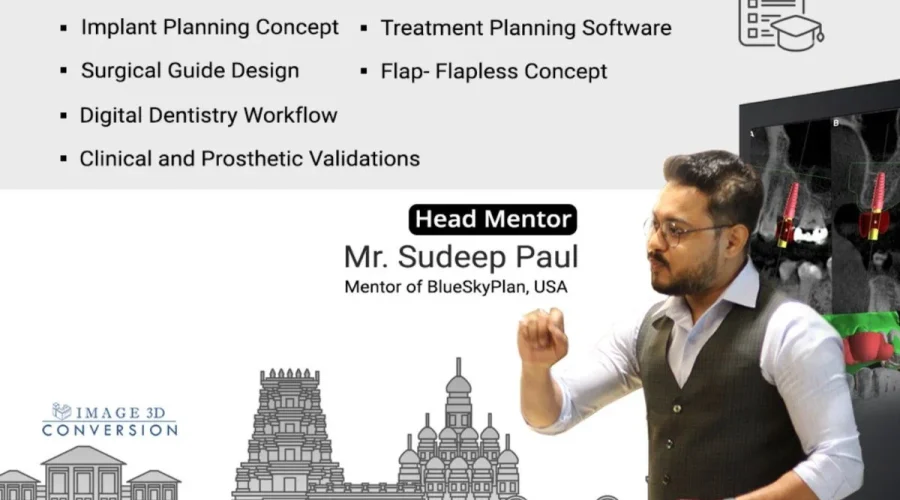
You will get knowledge from the basics to the advanced level of implantology with hands-on sessions. The topics which will be included in these two days are as follows:
- Implant Planning concept
- Surgical guide design
- Digital dentistry workflow
- Zygoma Planning & Guide Design
- Meshmixer mastery
- 3D printing
- Treatment planning software
- Flap-Flapless concept
Benefits of Attending the Workshop
In these workshops, you will understand the principles, resources, and right usage to transform traditional practice into digital. You will get tips and tricks in guided surgery for single to multiple-implant planning. Also, get exclusive professional software training to create your surgical guides. This will be an in-depth understanding of the science and engineering behind guided surgery. These techniques will improve your implant success rate and patient satisfaction.
Course Benefits
- Become a pro in cutting-edge techniques from industry leaders.
- Get comprehensive training in both the clinical and technical aspects
- Get hands-on experience to apply your newfound knowledge in real-world scenarios.
- Receive professional software training used to create precise surgical guides.
- Enjoy networking opportunities with fellow dental professionals around the world.
- Boost your dental career with new opportunities in digital implant surgery.
- Access exclusive resources and materials long after the workshop ends.
- Get Post-Workshop Support and guidance, helping you implement what you’ve learned.
- Receive a Blue Sky Bio (USA) certificate that enhances your professional credibility and career prospects.
You will also get Post-Workshop support and guidance to help you implement what you have learned.
Conclusion
The field of zygomatic implants continues to evolve. Ongoing research aims to improve further implant designs, surgical techniques, and postoperative care. Additionally, integrating digital technologies, such as computer-guided surgery and virtual planning, will likely enhance the precision and predictability of zygomatic implant placement.
If you want to grow in your career and enhance your dental practice, explore the workshops designed for enthusiastic dental professionals like you. Learn more about the workshops by clicking on the image.
Also Read: Zygoma Implants: Everything You Need to Know
FAQs
Zygomatic implants provide strong foundations for restorations, such as dental bridges or dentures, allowing patients to regain the ability to speak and chew comfortably.
If you are a certified dentist, you need to register by clicking the tab ‘register now’ here and fill in your basic details. That’s it; you are registered with us!
References
- Aparicio, C., & Ouazzani, W. (2008). “The use of zygomatic implants for prosthetic rehabilitation of the severely resorbed maxilla.” Periodontology 2000, 47(1), 162-171.
- Maló, P., de Araújo Nobre, M., & Lopes, A. (2009). “The use of zygomatic implants for prosthetic rehabilitation of the severely resorbed maxilla.” Clinical Implant Dentistry and Related Research, 11(1), 62-69.
- Aparicio, C., & Perales, P. (2007). “The zygoma anatomy-guided approach for zygomatic implant placement.” Periodontology 2000, 45(1), 41-47.
- Chrcanovic, B. R., & Abreu, M. H. G. (2013). “Survival and complications of zygomatic implants: A systematic review.” Oral and Maxillofacial Surgery, 17(1), 81-93.
- Bedrossian, E., & Sullivan, R. M. (2013). “The zygoma quad implant: a simplified approach for the severely resorbed maxilla.” Journal of Oral Implantology, 39(3), 314-322.
